Sacred energy patterns and harmonics are the basis for what we perceive as beauty, love, health, truth, and unity. Through our internal sense of proportion and order, we can identify and recognise dissonance and resonance.
— L. Laskow
The fundamental principles of working with frequency and sound healing begin with dissonance and resonance, terms drawn from music yet deeply relevant to the body.
Dissonance reflects tension, fragmentation, or incoherence within the system.
Resonance speaks to harmony, alignment, and natural order.
Through the application of sound and frequency, the body is offered a reference point. And through sympathetic resonance, it begins to reorganise itself.
This is the essence of sound healing. A precise and intelligent process that supports the body in returning to its inherent state of coherence.
What Are Dissonance and Resonance in Sound Healing?
Dissonance and resonance originate as musical terms, describing the relationship between tones. When applied to the human body, they describe energetic and physiological states.
- Dissonance may present as stress, nervous system dysregulation, or energetic fragmentation
- Resonance reflects coherence, balance, and integrative functioning
Sound healing works by identifying and gently interacting with these states. Rather than suppressing symptoms, it addresses the underlying patterns that shape them.
Through carefully applied sounds, tones, frequencies and intervals, the body is invited into a state of resonance, from which it can begin to heal itself.
The Principle of Sympathetic Resonance
Sympathetic resonance occurs when one vibrating system influences another to oscillate in harmony.
When the body encounters an external source of coherent sound or frequency, it begins to entrain. This means it naturally adjusts its internal rhythms to align with what it perceives.
The body has an innate capacity to orient towards order when it is exposed to it.
When the frequencies of the body are out of balance, disease may arise. Sound can restore harmony.
— Jonathan Goldman
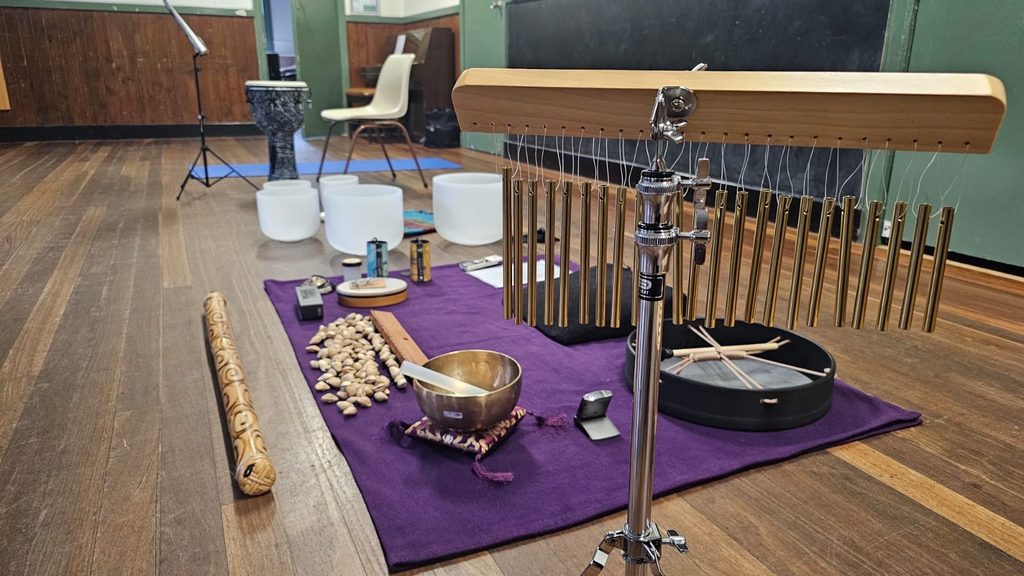
In sound therapy, instruments such as the voice, gongs, tuning forks, and singing bowls act as carriers of organised frequency. They offer the body a stable reference point from which reorganisation can occur.
A Brief Historical Context of Sound Healing
The use of sound as a healing modality is both ancient and cross-cultural.
- In ancient Greece, Pythagoras explored the relationship between musical intervals and universal harmony, describing what he called the “music of the spheres”
- Indigenous cultures have long used rhythmic drumming, chanting, and tonal instruments in ceremony and healing
- In Tibetan traditions, singing bowls have been used for meditation and energetic alignment
- Modern sound therapy integrates these traditions with contemporary understandings of neuroscience, vibration, and biofield science
Across these lineages, a common principle remains. Sound is not only heard, it is experienced throughout the body as vibration. Energy Vibration & Sound Healing Explained
Sound will be the medicine of the future.
— Edgar Cayce
How Sound Healing Supports the Body’s Reorganisation

Nervous System Regulation
Coherent sound patterns can guide the nervous system out of heightened stress states and into parasympathetic regulation. This supports rest, repair, and integration.
Energetic Coherence
Dissonant energetic patterns can gradually soften as the body entrains to harmonic frequencies. This restores a sense of internal order.
Cellular and Structural Effects
At a fundamental level, the body is vibrational. Sound interacts with tissues, fluids, and cellular processes, influencing how systems communicate and organise.
Why This Matters for Healing
Healing, in this context, is not something applied from the outside. It is something the body does when the right conditions are present.
Sound provides those conditions.
It offers coherence where there is fragmentation. Rhythm where there is irregularity. Stillness where there is excess noise.
Through resonance, the body remembers its own intelligence.
Begin Your Experience
If you are feeling the pull towards deeper balance, coherence, and restoration, this work is best understood through direct experience.
You are welcome to explore a personalised sound healing session or immerse yourself in a group sound bath. Each offering is designed with precision and care, meeting you exactly where you are.
Visit ishabae.com to learn more or make a booking.
Frequently Asked Questions
What is meant by dissonance and resonance in sound healing?
Dissonance and resonance are musical terms used to describe states of tension and harmony. In sound healing, dissonance reflects areas of stress, imbalance, or incoherence within the body. Resonance refers to alignment, balance, and natural order. Sound therapy works by gently guiding the body from dissonance towards resonance.
How does sympathetic resonance work in the body?
Sympathetic resonance occurs when the body encounters an external frequency that is coherent and stable. The body naturally begins to attune to this frequency, adjusting its own internal rhythms. This process supports reorganisation, allowing the system to move towards balance without force.
Can sound healing help regulate the nervous system?
Yes. Sound healing can support the nervous system by encouraging a shift from heightened stress states into deeper relaxation. Through consistent, coherent frequencies, the body is guided into parasympathetic states, which are associated with rest, repair, and integration
What does it feel like to experience resonance in a session?
Experiences vary. Some people notice a deep sense of calm or stillness. Others may feel subtle internal shifts, emotional release, or a softening of tension in the body. In many cases, the effects continue to unfold after the session as the body integrates the experience.
Is sound healing scientifically supported?
There is growing research exploring the effects of sound, vibration, and frequency on the body, particularly in relation to stress reduction and nervous system regulation. While aspects of sound healing extend beyond conventional scientific models, its physiological effects are increasingly being recognised.
Do I need to understand frequency or music for sound healing to work?
No. The process does not rely on intellectual understanding. The body responds directly to vibration and frequency. Sound healing works through experience rather than analysis.
How many sessions are needed to experience results?
This depends on the individual and what is being addressed. Some people notice shifts after a single session, while others benefit from ongoing work to support deeper or more complex patterns. Consistency allows the body more time to reorganise and stabilise.